RIDE TO CONQUER CRPS 2008
Welcome to the Press Room!
INTERVIEWS
Dr Shulman is available for interviews about his RIDE EXPERIENCE. Please put INTERVIEW in the subject line and send e-mail request to:
PARC.
PRESS RELEASE
June 1, 2008
PAIN SPECIALIST TO CYCLE FROM ONTARIO TO NEWFOUNDLAND TO RAISE FUNDS FOR CRPS RESEARCH
For Immediate Release:
Dr. David L. Shulman, a chronic pain specialist at Toronto’s Rothbart Pain Clinic, will cycle from Marathon, ON to St. John’s Nfld. in July to raise awareness of Complex Regional Pain Syndrome and money for its research.
The Ride for CRPS will kick off Saturday, July 19 and wrap up in St. John’s 21 days later, with Shulman having cycled 3,750 km. Shulman, who treats a number of people with CRPS in his busy practice, hopes this ride will raise awareness of a disease that “is a bit of a mystery” and funds into research of better treatment options.
“Those with CRPS are perhaps the most challenging of my patients and the most distressed,” he says.
CRPS is an organic disease caused by nerve damage in the small C fibres of the body. It usually results from trauma but not always. Shulman says,
“It’s a severely disabling condition marked by a sharp, burning pain that surpasses almost any other chronic pain condition in its intensity.”
On the McGill Pain Index, CRPS rated 42 out of 50 compared to 28 for cancer pain.
Shulman has designated PARC (Promoting Awareness of RSD and CRPS in Canada) and the McGill Centre for Research on Pain as the beneficiaries of his Ride to Conquer CRPS. PARC is a registered charity, which advocates for people with CRPS through a help line, bi-annual seminars, a quarterly newsletter, and soon—through funds raised from the Ride to Conquer CRPS—Doctor Education.
Helen Small, PARC’s Executive Director, says,
“Money raised will not benefit P.A.R.C. per se, but people with CRPS through a Doctor Education Program. Doctors will be able to recognize, diagnose and treat patients with CRPS better. We already have the specialists lined up to provide the training, all we need now is the funding.”
Early diagnosis is the key to fighting CRPS before it has a chance to wreak havoc on the nerves. The success rate is highest if diagnosed and treated in the first three months. After six months, the chances of success drop precipitously. Unfortunately, only about 30 per cent are diagnosed in those crucial first three months due to a lack of medical education. A PARC survey in 2006 also found 1 in 2 or nearly 50 per cent are not diagnosed early. Further, 2 in 3 or 66.08 per cent saw three or more doctors before being correctly diagnosed.
Doctor education is only half the battle, Small says. Research, such as that being done by Dr. Gary Bennett, PhD, Canada Senior Research Chair, Department of Anesthesia, McGill Centre for Research on Pain, and his team is equally important. One of the frustrations for Shulman and CRPS patients is that no cure currently exists. Bennett, who is organizing a conference in which Shulman will participate on July 28 at the Montreal General Hospital, says research is expensive and welcomes any funds raised through the Ride to Conquer CRPS.
“CRPS research will lead to better treatment and a cure. Any McGill research that leads to better treatments for CRPS will benefit Canadians first,” Small says.
At the end of Shulman’s second week he will meet up with Dr. Harry Pollett, Medical Director at Pollett Pain Services in North Sydney, NS. Pollett also serves as PARC’s Medical Advisor. From North Sydney, Shulman will ferry across to Port aux Basques and onto St. John’s. A reception is being planned to wrap up the Ride to Conquer CRPS.
Pollett estimates 1 in 60 has a lifetime risk of getting CRPS.
by Willy Noiles
Media Contact:
Helen Small, Executive Director, PARC
905-934-0261 OFFICE Help Line
E-mail: rsd@rsdcanada.org
MY SUMMER VACATION
in JUNE 2008 PARC PEARL
BY WILLY NOILES
Imagine using your summer vacation to cycle half way across Canada to raise awareness and funds for a disease that many have never heard of. One Toronto area physician will do just that in July when he rides his bicycle from Marathon, Ont. to St. John’s, Nfld. in an effort to raise awareness and research funds for CRPS.
Dr. David Shulman, a specialist in treating chronic pain at the Rothbart Pain Clinic in Toronto as well as being on staff at Markham-Stouffville and Ajax-Pickering Hospitals, will use his three-week summer vacation this year to raise much needed research funds by cycling. “It’s a good way to raise money for awareness and advocacy for CRPS,” he says. In the process he’ll complete a personal goal of cycling from one coast of Canada to the other.
Last summer Shulman cycled from Vancouver, B.C. to Marathon. Along the way he helped raise funds for an environmental awareness group. This summer he intends to complete that journey and help raise funds for CRPS/RSD. “This year I decided to move on to something a little closer to my work and something that needs the support,” Shulman says.
In his busy practice, Shulman treats a number of people with chronic pain, including those with CRPS, “a severely disabling condition” that is marked by a sharp, burning pain “that surpasses almost any other chronic pain condition” in its intensity. Those with CRPS or RSD, as it used to be called, are “perhaps the most challenging of my patients and the most distressed.”
Shulman emphasizes with those affected by CRPS and is well aware of the impact it can have on his patients’ lives and the lives of those around them. At the same time, it’s frustrating for him as a physician because CRPS “is a bit of a mystery.” It can be the result of trauma or no trauma. And while there are treatments that can help alleviate the pain, “we have no cure.”
But there is active research going on at McGill University, led by Dr. Gary Bennett, into CRPS. Half the proceeds from Shulman’s cycling marathon will go towards this research centre. The other half will go towards P.A.R.C. to support its advocacy work. “It’ll be helping P.A.R.C. to function by supporting research and advocacy,” he says.
Realizing the lack of support his patients have was one of the sparks that lit his quest to support CRPS on this summer’s cycling trip. Unlike those with lung cancer, heart disease, MS, AIDS, Lupus or many other diseases, those with CRPS have no large national organization fundraising year-round to find a cure. Shulman says P.A.R.C. helps fill that void.
The main influence that “stimulated and encouraged” Shulman to support CRPS, he says, was Helen Small, the executive director of P.A.R.C. “I took my lead from Helen, from her energy, her ideas and her advocacy for RSD.”
A believer in physical activity, Shulman rides most of the year. He makes a point of cycling to work each day he can. When he is unable to bike to work, he’ll run. He covers a distance of 50 km round trip each day, some days more. To prepare for this trip, he began riding more this spring.
When he rode from Vancouver to Marathon last year he covered about 190 km a day. “I wasn’t pushing it too hard,” he says. His challenge last July was getting through the mountains of British Columbia. The second day “was the hardest day of the trip,” he explains. “I was sore but pushed on and by the third or fourth day was OK.”
In the blog he kept of last year’s trip, on Day 4 (July 6, 2007), he wrote: “My daily distances are limited in B.C. due to the climbs and descents. There are at least two major climbs per day. I love the climbs but hate the descents.” Getting through Alberta’s Crow’s Nest Past, he says, was “quite a climb. The wind was howling.” To top it off, he got a flat tire near the top.
Along for the trip was wife Ahouva, a university professor, who drives the van. Before heading off each day, they would decide upon where to meet up for lunch and off they go, separately. They have cell phones and walkie-talkies (because there’s no cell coverage in some places) in case they need to reach one another. He also carries two bottles of water and a snack with him. Ahouva is “quite gregarious,” he says, and has a good time checking out various artisans along the way. One might think it would be lonely to cycle alone over long distances. Not so, he says. “There’s too much to see to get bored.” And in addition to the scenic views, there are the other cyclists he meets along the way. Some will ride a few miles with him. And some drivers will blow their horn in support.
He cycles about 12 hours a day. Around 7 or 8 p.m. he’ll meet up with Ahouva and they’ll have supper and pack it in for the day. At night they’ll camp or get a motel room.
Unlike last year where he didn’t have to ride through big cities, he’ll have to tackle Ottawa, Montreal and Quebec City this July, which means riding on the highways. He’s currently consulting maps in an effort to avoid the highways as much as he can. His other challenge this year will be the Cabot Trail, which is “quite hilly.”
This year’s Ride for CRPS will kick off Saturday, July 19 in Marathon. During the first week he estimates he’ll travel to Montreal. He’ll make a stop in Montreal at McGill where there are plans to participate in a conference. He hopes to reach Cape Breton by the end of the second week. In Sydney, N.S., he’ll tour Dr. Pollett’s pain clinic. By the end of the final week, he plans to hit St. John’s, where there’ll be a reception. He has 18 days to complete the trip, which he hopes will allow one day to start, one day to return home and hopefully one day to rest in the middle. On the nineteenth day, “I’ve got to get back to the office.”
Sounds like a lot of hard work for a summer vacation. Shulman, however, doesn’t look at it that way. “It’s a great way to see Canada,” he says.
As he counts down the days to his summer vacation, he’s getting inspiration from Troy Grimes, who’ll be running 50 miles from Big Spring to Odessa, Texas to raise awareness and funds for the RSD Association (RSDSA) in the U.S. “He provides a lot of motivation for me.”
By the end of this year’s summer vacation, he hopes to have raised a good deal of awareness and money for RSD as well as promote exercise. “Hopefully it will encourage more physical activity and more awareness of RSD,” Shulman says with hope evident in his voice.

RIDE ROUTE
To view Dr Shulman's route map from Marathon ON to St John's NL,
please CLICK HERE or go view the list of cities on the RIDE BLOG page below.
Stay tuned for the RIDE BLOG beginning July 19th!
B.E.T.
BY AYALA RAVEK, CRPS/RSD SURVIVOR
(Speech at National Canadian Pain Society conference)
Hi, my name is Ayala. I'm a singer... an artist.. a writer... a hiker... and a full-time high school student. I'm a 15 year-old from Ottawa... And I have chronic pain.
It's hard to believe that I am the same person, who in 5 years of having full-body chronic pain, had been hospitalized, in a wheel chair, and suicidal, to now, being in control of my own life, and my pain.
On March 13th, 1998, I had been in a floor hockey game in gym class. I was defense, protecting the net, when my classmate on the opposite team whipped the puck that slammed into my kneecap. It's difficult to describe the type of intense pain I felt.
The first doctor I saw said that although doubtful, I may have a broken kneecap. The idea of a broken kneecap scared me slightly, as it required surgery to fix. X-rays showed nothing, and my knee could not be examined as it was so swollen.
Due to relentless pain, I started missing a lot of school. I wanted to stay in my room and not go anywhere. I was on and off crutches, using them as little as possible because I didn't want to look like a complainer, I wanted to be strong.
On one of the off-crutches days, I was going down the concrete stairs at school to go home when my leg collapsed, and I fell down the entire flight of stairs. Perhaps, had I not been so stoic and focused on continuing in school for as long as I could, this would not have happened. Although I got up on shaky legs, I brushed off the pain, picked myself up, and continued on. After my fall down the staircase, the pain spread. First in my other leg, then my hands and arms, then my back and neck.
Physically, what was visible in X-rays, bone scans, and MRIs, showed that nothing was wrong. But I certainly didn't feel right; not only due to the pain in my body, but the way people viewed me.
My classmates saw me through suspicious eyes. I was a faker..Nothing was wrong with me!I was skipping classesConning my parents. ..Just making excuses to get sympathy..
My teachers looked down upon me. If I wasn't there, why should they bother with me?î... It was my fault that I couldn't keep up with school work anyway!!
Like my pain, I felt invisible. If being completely isolated from those I had been closest to was not enough, I also got it from doctors, It's just growing pains!...I'm too sensitive I just wanted attention!.. And the best one: It was all in my head!!!
My wanting to end everything came now not only from the agony I was in, but from the disbelief of others that my agony was real! Was I making this up? I was no longer sure. Perhaps I truly was insane!
Nothing mattered much at this point. I hated everything and everyone. But being stoic and not liking to complain, I kept most things to myself.
I felt that nothing was being done to help me. I felt like tearing my hair out and yelling at the top of my lungs: Enough! leave me alone already! I cant take it anymore!!
That was the point I was at when I finally got my diagnosis, eight months after my initial injury.
Reflex Sympathetic Dystrophy. A disease that affects the sympathetic nervous system. There really was nothing wrong with my body... my nerves just continued to send pain signals to my brain!!!
The way this was explained to me though, at 11 years of age, made me think that yes, in fact the pain really was in my head!
But at least now the pain was legitimate.
So what could I do to help myself? Don't take opioids and do pain management,it was the thoughtful recommendation of the pediatric neurologist who finally diagnosed me. That didn't help me much.
Even at school, for the few hours I attended, I didn't know how to explain my condition. I wasn't really clear as to what it was that I had. So still, I was considered a faker, conning my parents.
Most of my time was spent in my room, not wanting to see anyone. I read and I listened to music. I went to physiotherapy twice a week, I went to pain management twice a week... and I hated everything and everyone. I didn't want to talk to my parents, I didn't want to play with my younger brother and sister, I didn't want well-meaning relatives to visit, I didn't want my normal peers to call me. I just wanted to be left alone.
I was unaware how much my parents did to try and find help for me. At that point, I didn't care. I later learned that they searched for help all over the world, spending countless hours on the internet and on the phone.
Finally, with the help of my aunt in Toronto, my parents made contact with the newly established Pain Team at Sick Kids Hospital. I was admitted January 20th, 1999.
I had thought things would be better in the hospital.
I thought that I would finally be believed; now that my pain had a name.
How wrong I was!
I only have bits and pieces of memory from my time in the hospital. One memory stands out in my mind. I was on a hospital bed. Surrounding me, filling up the room, and spilling out into the hallway, were white coats and poking, prodding hands.
I remember wanting to cry out, wanting to scream and shout. But I couldn't. I wouldn't let myself. I had always been quiet and uncomplaining. And that way I would stay. I would not cry until the horde of doctors left me. Even after, the tears would not be completely heartfelt. I wanted to cry harder, but still, I could not.
My mom, who stayed with me, my dad in Ottawa with my younger siblings, told me that at night I would cry out and thrash in pain.
My first epidural was hell. Most of the time I put on a relatively good face. But it was all a facade. I just wanted to be out of pain.
Well, the epidural, once inserted in my lower back did its job for the most part.
I just couldn't. feel anything. From the waist below, I was completely and utterly numb. It is a sensation that is hard to describe, except that it was so strong, I can still feel it. It was a miserable sensation. It terrified me. Not only because I could feel nothing, and I couldn't. walk or move, but the pain was still there. I was terrified that I would pee in my pants or in bed. So added to the horrible numbness, came a shame I can remember as clearly as though it were yesterday.
Not much is remembered from that stay of three months. Bits and pieces of memory, most of which I want to forget. I mostly wanted everyone to leave me alone.
Even as an outpatient after the unsuccessful epidural. I stayed with family. I didn't want to talk to them or face them. They were normal. I wasn't. They made fun of my pain. I didn't like that, and I avoided them as often as I could. I don't exactly remember what started it, and I don't completely understand why I did it, but I started picking the skin off my fingers, drawing blood, until all ten fingers were just meaty flesh.
After a while, picking my fingers wasn't.good enough. I started picking the skin off my arms as well. They too became raw.
And when I'm really cold, my arms discolour slightly, and I can still see where I dug holes into my skin.
I don't remember much of my return home to Ottawa. I had switched schools, but I didn't really care. I tried to care for the sake of my parents and family; I don't know how well I succeeded. I went as often as I could to school, just to prove to myself that I was able to, even if it was for only an hour.
To go back in time for a minute... I had been seeing a psychiatrist at Sick Kids who I called Dr Froggy. She tried to help me become more comfortable with explaining pain and the way I felt to other people. She suggested a scrapbook, which I dutifully filled up with get well cards from people I knew meant well, but I didn't want to hear from.
PART TWO DECEMBER.
From the idea of a scrapbook evolved the idea of a web site, and I started www.NoPainZone.com with the input and help of my parents.
I remember my entire grade 6 class visiting my web site in the computer lab, and all the emails I got from them; that made me feel a bit better.
It also made me feel good when other people from around the world who had RSD began emailing me as well. I had thought myself alone. But the amazing thing was that I wasn't.
I was not alone!
That revelation was very slow in coming. It went through grades 7 and 8 with me. I still wasn't. the happiest person in the world, though not many would have realized it, or know to this day that I felt messed up inside. Not only because of the pain, but because I was different.
My experiences were unlike those of my classmates. And my outlook and priorities were different, such as the fact that I could get out of bed each morning... that I could dress myself, smile, try to laugh... those mundane things were a huge feat for someone who lives in pain.
Grade 8 was the start of a turning point. Not only because of my web site and the great number of people with all conditions of pain who I began to correspond with, but also because my pain levels were lower. I was around a 6 out of 10 most of the time, sometimes a bit lower.
I finally realized that I was not isolated from other people my age. I became friends with some of them, and while they couldn't. even begin to understand all I'd been through, they respected me for what I was.
A fighter. I was the person who helped others and would not let my pain stop me.
I still missed a lot of school, but I was functioning almost as well as my peers.
Summer came and went; high school was a whole new experience to look forward to, one I was eager to embrace.
After a lengthy and challenging audition process, I was accepted at the prestigious arts High School, Canterbury, in their vocal music programme. Unfortunately, the hours were too early for me. I'm not a morning person as I sleep little and what little sleep I get is not good quality.
I missed most of the mornings, the time when I had music classes. Since I wasn't. able to be at school to perform, I couldn't. be properly assessed.
The size of the school made me feel lost. I had no friends, and I missed a lot of classes. It was difficult, still getting used to the school system. It got to the point where I felt depressed and panicky in the building.
So with a touch of sadness and regret, I decided to switch to a private school which my best friend of 11 years attended. It had been my goal to attend Canterbury's vocal programme, but I accepted that it was not meant to be.
This year is my second time around in grade 9, as I hardly attended grade 9 last year.
Learning to deal with being what society calls physically disabled is not my only accomplishment. Since my 12th birthday, I have become a one person show, obsessed with promoting greater awareness of pain issues... in numerous newspaper articles, radio and TV interviews.
I received a Lifetime Acheivement Award from a Canadian RSD group.
Last winter I was a Nutella Little Champion, and my story appeared on the label of the hazelnut spread across Canada. .
I've written a chapter for a Nursing textbook about living with pain...
as well as a section on Self-Esteem for a grade 4 Quebec textbook, A Window On the World.
Last April, I received the Ontario Junior Citizen of the Year Award by the Lieutenant Governor of Ontario.
I take part in my school's performance troupe, Raneinu, in which I sing, act and dance.
I sang in 3 singing competitions this year.
And I've been a full-time student for the first time in 5 years.
That is just a few of the things I've accomplished.
Along the way, I've reached an inner peace. I've learnt forgiveness for those who had done me wrong. I've learned compassion for those around me, and for those I help. Understanding, for my parents who did everything in their power to help me, although I did not appreciate, nor care about it, until recently. I now take my brother, Amir, and my sister, Ariela, to the park... I laugh and play with them... they can annoy me in the way only younger brothers and sisters can! And I love them.
I owe a lot to my Toronto Pain Treatment Team. During dark times, when I was a real brat, Jennifer and Kristi and Dr Brown, still gave me the understanding and help I needed. They did not hold me back from being weaned from the 21 pills per day I had been taking.
For nearly 3 years, I have been med-free! And they encouraged me when I was interested in seeking out alternative therapies.
With the help of my Dad, who became my coach, I have learned to do guided imagery, creative visualization, meditation, Reiki, massage, E.F.T., magnet therapy, and accupressure points.
I have graduated from the Physio/Aquatherapy clinic I used to attend twice a week and I have modified my vegetarian diet, eliminating junk food and dairy products, and I eat mostly organic foods.
For the past 4 years I exercise each day... my program includes yoga, stretches, treadmill, crosstrainer, bike, and weights. I love to hike, swim, and I recently got on a bicycle outside for the first time in years. I fell, but that's okay, I have all summer to learn!
I'm a happy person. I learned, over the past summer, that pain does not define me. I am not Aya who has chronic pain.
Pain might share a body with me, but that means nothing.
I am Aya. I help others. I'm a student. I'm a teacher. I see, I feel, I love, I laugh.
I'm like you. Not a specimen who has a long-named disease.
My focus now is to educate.
To tell health care providers that patients who suffer from chronic pain have feelings. And they hurt. And they need your understanding and your help.
I urge everyone to B.E.T.
BEE... EEE... TEE...
Believe... Empathize.... Trust.....
BET on your patient!
(SMILE!)
Thank You.
PRESS FILES:
ENGLISH: RIDE TO CONQUER CRPS presentation file : RIDE.ppt
ENGLISH: CRPS/RSD presentation and RSDCANADA Survey: WHATISCRPS.ppt
FRENCH: WHAT IS CRPS/RSD?: SRDC
FRENCH: PRESS RELEASE: FRENCH PR
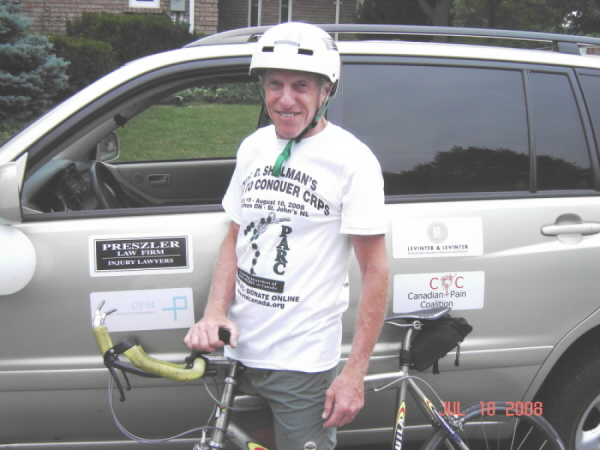
PHOTO OF DR SHULMAN
PHOTO OF DR SHULMAN
PRE-DEPARTURE PHOTO: JULY 18
|